My acquaintance with China began several years before I came to the University of Science and Technology (USTC). While working on my thesis on the search for the associated production of neutral gauge bosons in the ATLAS experiment, I collaborated with several bright and talented young Chinese scientists: Hulin Wang, Shu Li, Yusheng Wu. Already before my defense in the autumn of 2017, I received an invitation from prof. Yusheng Wu to continue my scientific career as a postdoc in USTC. I gladly accepted this offer and in the spring of 2018 went to visit my new university.
In China, I was hosted warmly. First of all, I was impressed with the scale of the USTC, which territory resembled a small city. It provides students and researchers with all the necessary facilities nearby. As I later discovered from visiting Tsung-Dao Lee Institute in Shanghai with a seminar, a large campus is a common feature of all Chinese universities. However, no matter how big USTC was, my intention to explore Hefei took me outside the university gates. Until that moment, I knew about China from books that it is a friendly country for Russia with a rich history and great heritage. And this information was fully confirmed. I was also amazed by how centuries-old traditions are closely intertwined with modern technologies and, of course, by the variety of Chinese cuisine. Some dishes became my favorite choices even outside China.
Thanks to my colleagues I quickly went through the registration with the USTC and got down to work. My research remained connected with the ATLAS experiment at the Large Hadron Collider (LHC), however, the focus was changed. My supervisor prof. Yusheng Wu suggested that I get involved in the studies of Higgs boson production. In order to work effectively on a new task, I went to CERN and there I joined the USTC research group.
My next visit to China was in the winter of 2018. I participated in the China LHC physics workshop (CLHCP2018), where I presented a report on the latest results of the ATLAS collaboration on the study of the associated production of the Z boson and photon. This was my first experience of attending a conference in China. I met a lot of experts in my area of scientific interests and was very satisfied with the trip. A little later in early 2019, I learned from prof. Yusheng Wu about a special fellowship from the Chinese Academy of Sciences for postdocs. We unanimously decided to apply for it, and for this purpose, I came to China again in the spring. Which I was very happy about because spring has become my favorite season there. The USTC has a wonderful cherry blossom.
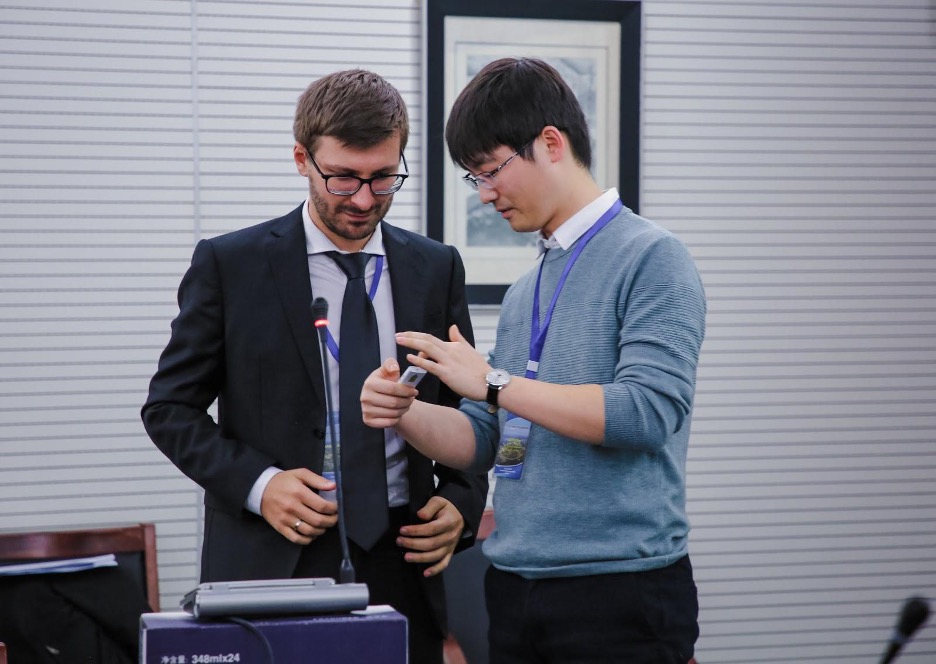
With prof. Yusheng Wu at CLHC2018
As a fellowship topic, we proposed research of rare Higgs boson decays. By this time, I was interested in such decays as 1) into two muons – the rarest and not discovered at that time Higgs decay into second-generation leptons 2) into “invisible” (for detectors) particles – a process that can explain the origin of Dark matter. At my return to CERN, I learned that the grant was supported. This news was very good since it allowed me to increase the time of my work at USTC. Right away I joined a working international group in ATLAS collaboration and focused on improving muon momentum measurement by optimizing tracking algorithms. This is one of the key points in the search for the Higgs decay into two muons.
The first results were ready by the end of the year and I presented them at the next CLHCP conference in Dalian. These were the first public results from the ATLAS experiment and from all LHC experiments on Higgs decay to muons, therefore, they generated a lot of interest. In Dalian, I had time to explore the city. Locals were very friendly, especially when they found out that I was from Russia. On the same visit, I managed to get to the famous Yellow Mountains and took with me to France a lot of impressions from China, including new knowledge about the tea ceremony.
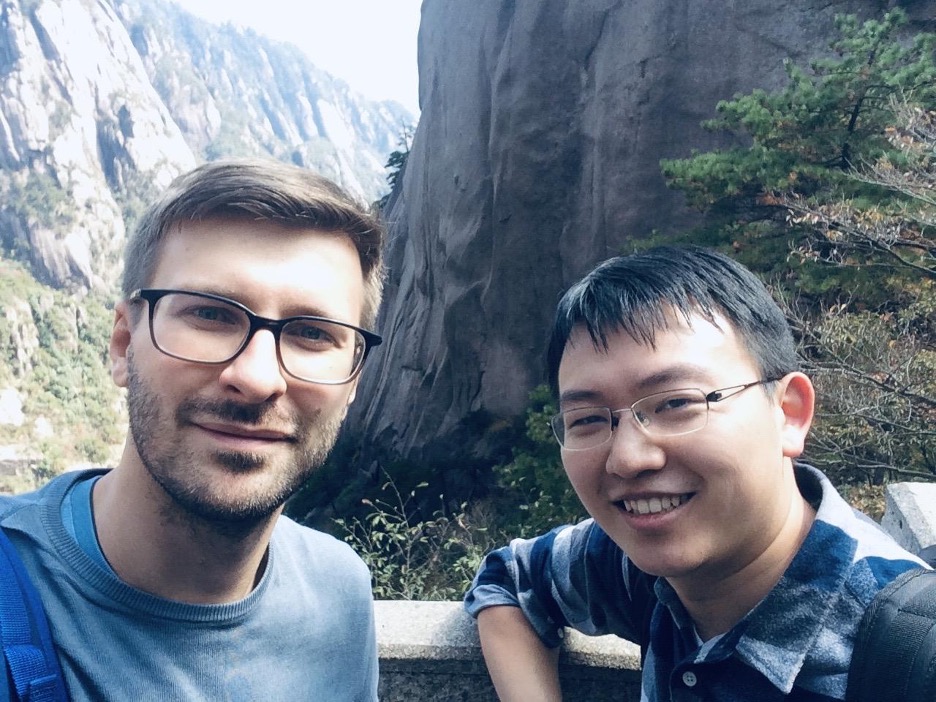
With student Xiangyu Xie at Yellow mountains.
At the next stage of my work, I switched to the study of associated production of Higgs boson and Z boson, where the Higgs decays into “invisible” particles and Z into leptons. In this group, my active work on the implementation of machine learning-based analysis methods was noticed and I was appointed in the summer of 2020 as analysis contact. The results of this study are expected to be published early in 2021.
It is impossible to fit all the impressions during the work with USTC and CAS into this text. I see a lot in common between the Russian and Chinese sciences and I will be glad if the cooperation of our countries in this area grows stronger. I am grateful to the Chinese Academy of Sciences for the opportunity to work at one of the leading universities in the world, the USTC team for useful advice, individually to prof. Yusheng Wu for help in my scientific work and organizational issues.
 Main page