Nowadays, outer space is becoming closer thanks to rapidly developing technologies, and the exploration of space is experiencing new growth. In the news, we often hear about breakthroughs in the development of spacecraft and future journeys into the cosmic void. In reality, besides the massive objects visible in the sky to the naked eye or through telescopes, there are endless streams of particles of matter and antimatter. These particles arrive at Earth, telling the story of their origins, the history of the universe. The same technologies facilitate advancements in fundamental research, which are crucial for future space missions and the overall development of humanity.
Recently, two articles were published where I served as the first author (in Nuclear Instruments and Methods in Physics) and the corresponding author (in Advances in Space Research). I decided it would be useful to accompany these publications with a brief popular summary, as well as my opinion on the current academia requirements for the publications. In the interest of brevity, I will skip the description of an incredibly efficient and precise experiment (the Alpha Magnetic Spectrometer or AMS on the International Space Station), which provided the data for these studies. More details about the experiment, of which I am also a member, can be found here. It would have been simply impossible to achieve such impressive results without the efforts of the collaboration members involved.
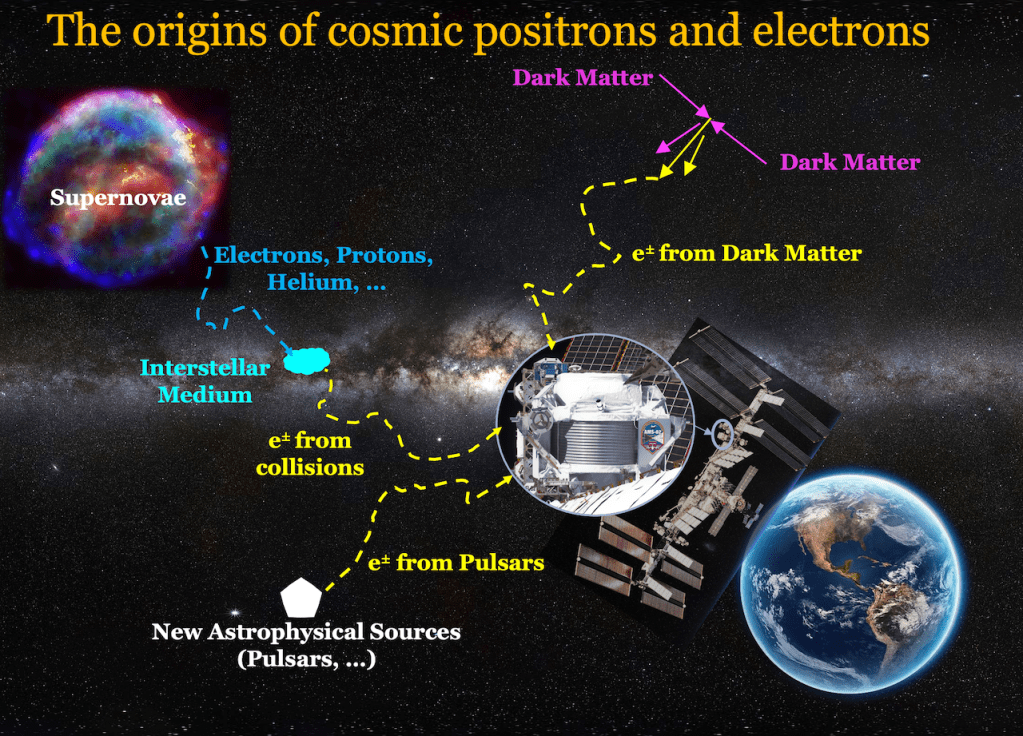
Cosmic ray elementary particles and antiparticles have different origins. Positrons (anti-electrons) can be produced in interactions of primary protons with the interstellar medium. Electrons could be accelerated with protons, helium and other primary nuclei by supernova remnant. A small portion of electrons can be produced in interactions of primary cosmic rays with the interstellar medium. Earlier AMS demonstrated that the observed complex behavior of the positron and electron fluxes is not consistent with the exclusive secondary production of these particles in collisions of cosmic rays.
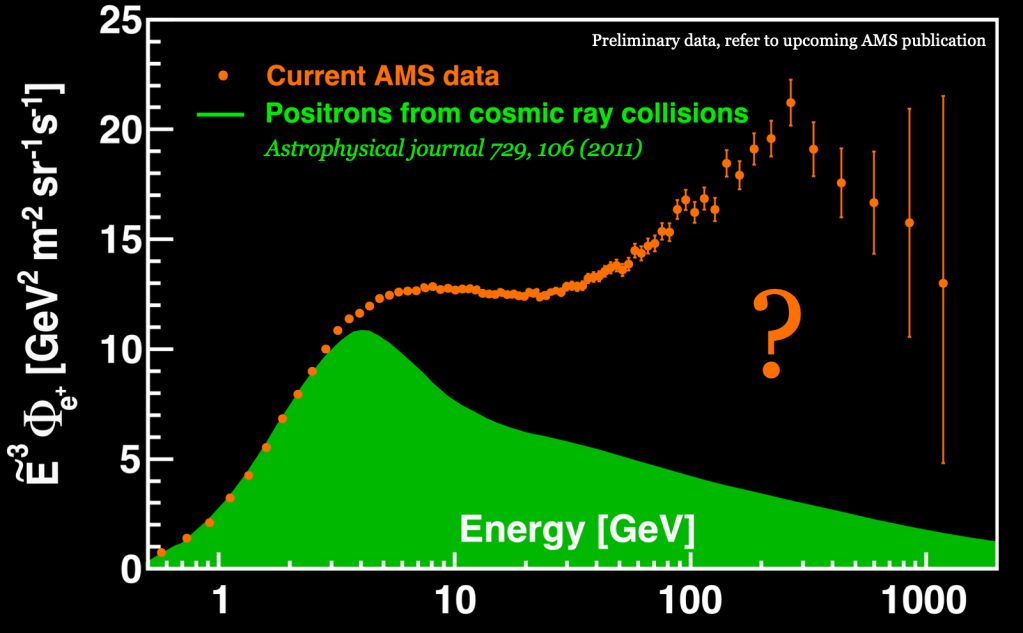
New AMS measurements revealed unique properties of elementary particles of matter and antimatter arriving at Earth. The results indicate the existence of a source of high-energy electrons and positrons, potentially related to Dark Matter or Astrophysical Origins. An important point is that the signal was registered simultaneously and independently in the fluxes of electrons and positrons. Preliminary data has been published, and the significance of the presented observation is limited by the statistics. However, if these observation is confirmed with a higher level of confidence, it may indicate the existence of New Physics. It is worth noting that the increase in statistics over the past two years has led to a rise in the significance of this published result.
In science, it’s not just statistics that influence measurements. Sometimes, key improvements in analysis methods and corresponding reductions in measurement errors play a crucial role. The second article discusses new methods for identification of high-energy elementary particles, including those based on machine learning. As is often the case, such materials will primarily interest a narrow circle of scientists working in the same or related fields. Nevertheless, I would like to emphasize that the complexity of the research being conducted requires increasingly intensive involvement of computers computations and sophisticated models. In our case, machine learning was carefully monitored and validated for physical meaning during training and in the final results, thus it was not a so-called “black box”. I hope that this foundation of scientific research (transparency at all stages) will be maintained in physics in the future.
Both articles are the result of long, patient work, which will obviously continue to draw final conclusions. In general, fundamental physics is largely about patience, and breakthrough ideas are based on long preparation. It is all the more challenging for young scientists in the current realities of academia, where publications are required at all stages of career growth, and the quality (journal) largely determines one’s future. I have nothing against establishing metrics to evaluate a scientist’s work. However, it is precisely fundamental research that is essential for the long-term development of humanity, and it seems that the pressure associated with frequent publications of breakthrough studies may work against this and lead to a depletion of this scientific frontier.
 Main page