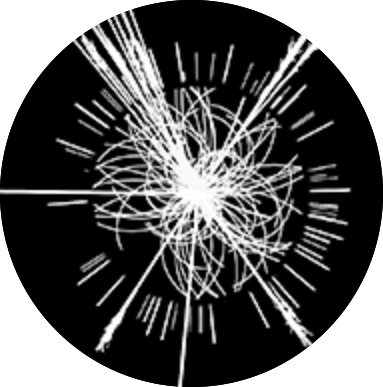
“The cosmos is within us. We are made of star-stuff. We are a way for the universe to know itself.” ― Carl Sagan
We are hunters of elementary particles. We hunt for particles of matter and antimatter, both those produced in Earth-based laboratories and those originating from outer space.
Today, at the European Organization for Nuclear Research (CERN), scientists accelerate protons to unimaginable speeds and collide them to simulate the first moments after the Big Bang – the event that marked the birth of our Universe. To measure infinitesimal distances and times, and to detect the traces left by particles, the most advanced detectors, essentially precise microscopes, are developed. These traces unlock the secrets of our world. In space, elementary particles arrive from sources still unknown to humanity. These sources, located light-years away, or even in other galaxies for some experiments, could be related to the annihilation of dark matter within our galaxy or particles born in the monstrous magnetic fields of neutron stars.
Whatever their origin, we are committed to capturing every particle, one by one, in order to piece together a picture of the Universe from billions of fragments.
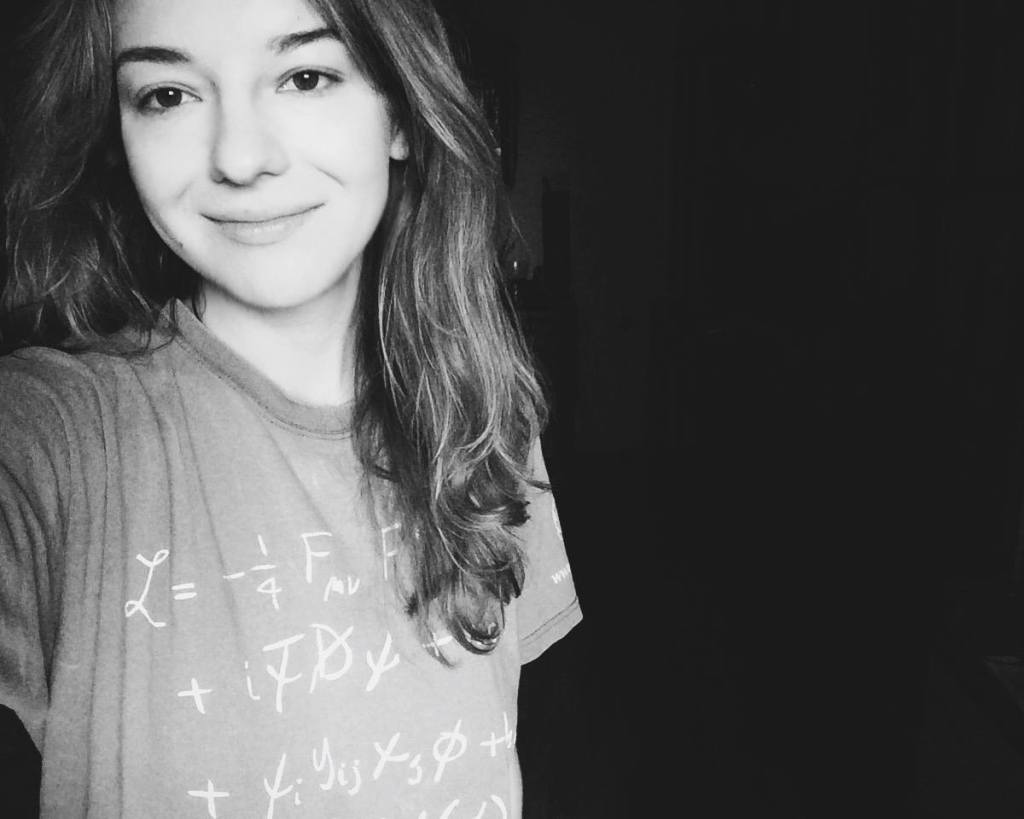
Ekaterina Krasnopevtseva, Outreach Specialist.
I was engaged in scientific communication firstly at Moscow Physics Engineering Institute and then at the Higher School of Economics. I covered the successes of Russian scientists in Large Hadron Collider collaborations (ATLAS and LHCb) for the institutes’ press. This included scientists interviewing, papers reviewing for public press releases etc. My attitude to scientific interviews always went with the desire to highlight the career path and individuality of each scientist I communicate with. I found such materials to be very useful for students who have yet to make their own path. I was involved in the organization of outreach events, such as institute surveys, invited talks, and open days. Photography is one of my passions, so it was very common for me to highlight scientific events from both sides (text and photo). After we relocated to the CERN area I continued to work for a while on the same topics at my husband’s affiliation institute at that time: the Chinese Institute of Science and Technology. That was the moment before COVID, so I traveled to China to help them with setting up a new department website. It required a lot of popular texts about science and interviews. At the same time, I volunteered at CERN open days and supported remotely some outreach events in Moscow.
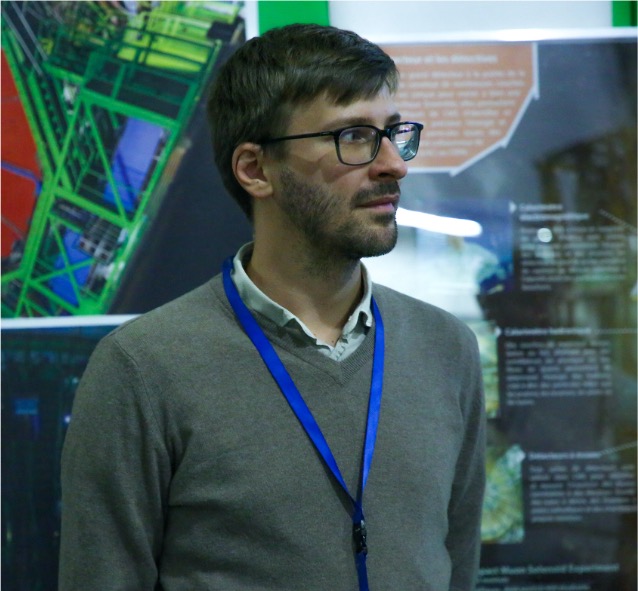
Dimitrii Krasnopevtsev, research scientist at Massachusetts Institute of Technology.
I obtained my Ph.D. in Russia and have since dedicated my career to particle and astroparticle physics, conducting research in Europe, China, and the USA. During my first postdoctoral position, I was invited by the University of Science and Technology of China as a High-Level Foreign Talent to investigate a crucial aspect of modern elementary particle physics: Higgs boson properties. In pursuit of this goal, I was based at the European Organization for Nuclear Research (CERN) in Geneva, actively participating in the ATLAS experiment at the Large Hadron Collider. In 2020, I received an offer from the Laboratory of Nuclear Science at MIT to join group of Nobel laureate Prof. Samuel Ting. My current research project focuses on measuring cosmic matter and antimatter using the unique apparatus known as the Alpha Magnetic Spectrometer on aboard the International Space Station.
 Main page